|
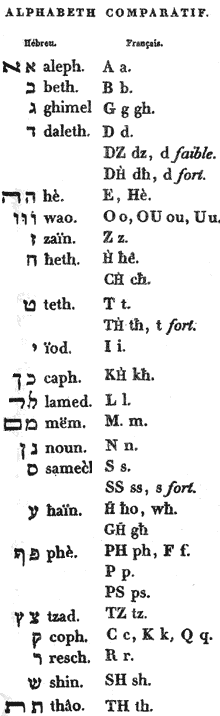
 P.PH. This character as consonant, belongs to the labial sound, and possesses two distinct articulations : by the first P, it is joined to the character P.PH. This character as consonant, belongs to the labial sound, and possesses two distinct articulations : by the first P, it is joined to the character , of which it is a reinforcement; by the second , of which it is a reinforcement; by the second , it is joined to the character , it is joined to the character become consonant and pronounced become consonant and pronounced . .
As symbolic image it represents the month of man, whose most beautiful attribute it depicts, that of uttering his thoughts. As grammatical sign, it is that of speech, and of that which is related thereunto. The Hebrew does not employ it as article; tut everything proves that many of the Egyptians used it in this way and thus confounded it with its analogue , by a peculiar affectation of the pronunciation. Perhaps also a certain dialect admitted it at the head of words as emphatic article in place of the relation , by a peculiar affectation of the pronunciation. Perhaps also a certain dialect admitted it at the head of words as emphatic article in place of the relation : this appears all the more probable, since in Hebrew, a fairly large quantity of words exist where it remains such, as I shall remark in my notes. : this appears all the more probable, since in Hebrew, a fairly large quantity of words exist where it remains such, as I shall remark in my notes.
Its arithmetical number is 80.
 PHA. That which is the most apparent of a thing, the part which first strikes the sight. PHA. That which is the most apparent of a thing, the part which first strikes the sight.
 The face of things in general; in a more restricted sense, the mouth, the beak; that of which one speaks with emphasis, that which is made noticeable. The face of things in general; in a more restricted sense, the mouth, the beak; that of which one speaks with emphasis, that which is made noticeable.
In Arabic this root displays its force in mouth, and in mouth, and in to speak. The verb to speak. The verb characterizes literally, thai which opens, separates, as the mouth. characterizes literally, thai which opens, separates, as the mouth.
 (comp.) Every kind of ornament, glory, palms. See (comp.) Every kind of ornament, glory, palms. See 
 PHB. Rooi not used in Hebrew nor in Arabic. PHB. Rooi not used in Hebrew nor in Arabic.
 PHG. That which extends afar, which wanders, is extended, loses its strength, its heat. PHG. That which extends afar, which wanders, is extended, loses its strength, its heat.
The Arabichas nearly the same sense. As noun, it is every kind of crudeness, unripeness; as verb, it is the action of separating, opening, disjoining, etc. crudeness, unripeness; as verb, it is the action of separating, opening, disjoining, etc.
 Action of being cool, freezing; of losing movement. Action of being cool, freezing; of losing movement.
 PHD. Every idea of enlargement, liberation, redemption. The Arabic PHD. Every idea of enlargement, liberation, redemption. The Arabic signifies to raise the voice, to show one’s self generous, magnificent, arrogant. signifies to raise the voice, to show one’s self generous, magnificent, arrogant.
The meaning of the Hebraic root is found in the compound which signifies literally to deliver. which signifies literally to deliver.
 PHEH. This root is the analogue of the root PHEH. This root is the analogue of the root  ; but in Hebrew particularly, it emphasizes the thing that one wishes to distinguish in time or in a fixed place; as in that very place, right here, this, that, these. ; but in Hebrew particularly, it emphasizes the thing that one wishes to distinguish in time or in a fixed place; as in that very place, right here, this, that, these.
 In a literal sense, mouth, breath, voice, in a figurative sense, speech, eloquence, oratorical inspiration: that which presents an opening, as the mouth; which constitutes part of a thing, as a mouthful; which follows a mode, a course, as speech. In a literal sense, mouth, breath, voice, in a figurative sense, speech, eloquence, oratorical inspiration: that which presents an opening, as the mouth; which constitutes part of a thing, as a mouthful; which follows a mode, a course, as speech.
The Arabic has in general, the same sense as the Hebrew. has in general, the same sense as the Hebrew.
.
 PHOU. This root is the analogue of the roots PHOU. This root is the analogue of the roots  and . and . : but its expression is more onomatopoetic in describing the breath which comes from the mouth. : but its expression is more onomatopoetic in describing the breath which comes from the mouth.
The Arabic is not far removed from the radical sense of the Hebrew. is not far removed from the radical sense of the Hebrew.
 (comp.) Action of blowing. See (comp.) Action of blowing. See • •
 (comp.) Action of hesitating. See (comp.) Action of hesitating. See
 (comp.) Action of spreading, dispersing, melting. See (comp.) Action of spreading, dispersing, melting. See . .
 (comp.) Action of being moved by an alternating movement. See (comp.) Action of being moved by an alternating movement. See
 (comp.) That which bursts forth, shines out, appears. See (comp.) That which bursts forth, shines out, appears. See . .
 (comp.) That which spreads abundantly, which overflows. See (comp.) That which spreads abundantly, which overflows. See . .
 PHZ. That which throws flashes, gleams, rays: which is sharply reflected: thence, PHZ. That which throws flashes, gleams, rays: which is sharply reflected: thence,
 Purest gold: keenest joy; a topaz. Purest gold: keenest joy; a topaz.
The Arabic characterizes the movement of that which rises quickly, spurts up, leaps, struggles, etc. characterizes the movement of that which rises quickly, spurts up, leaps, struggles, etc.
 Action of emitting sperm. Action of emitting sperm.
 PHER. Everything which is drawD in. expanded, as the breath; all that which is unfolded in order to envelop and seize, as a net; thence, PHER. Everything which is drawD in. expanded, as the breath; all that which is unfolded in order to envelop and seize, as a net; thence,
 Every idea of administration, administrator, state, government. Every idea of administration, administrator, state, government.
The Arabic constitutes an onomatopoetic and idiomatic root whicn describes every kind of hissing of the voice, snoring, strong respiration, rattling. When this oot is strengthened in, it signifies literally, an ambush; a trap. constitutes an onomatopoetic and idiomatic root whicn describes every kind of hissing of the voice, snoring, strong respiration, rattling. When this oot is strengthened in, it signifies literally, an ambush; a trap.
 Action of inhaling, expiring; respiring, blowing; actionof inspiring, communicating one’s will, governing. Action of inhaling, expiring; respiring, blowing; actionof inspiring, communicating one’s will, governing.
 (comp.) Every idea of breath, of lightness, of unstable thing. (comp.) Every idea of breath, of lightness, of unstable thing.
 (comp.) A yawn, an hiatus, a hole. (comp.) A yawn, an hiatus, a hole.
 PHT. An opening, a pit; a dilation; a prorogation given to something. PHT. An opening, a pit; a dilation; a prorogation given to something.
The Arabic signifies literally, to crumble: signifies literally, to crumble: to rise, leap. From the latter word is formed to rise, leap. From the latter word is formed which characterizes that which acts abruptly, with cruelty, etc. which characterizes that which acts abruptly, with cruelty, etc.
 Action of opening the mouth, yawning; figuratively, the action of crying, chattering, ranting, etc. Action of opening the mouth, yawning; figuratively, the action of crying, chattering, ranting, etc.
 PHI. This root is the analogue of the two roots PHI. This root is the analogue of the two roots  but its expression is more manifest. but its expression is more manifest.
 A beak; the orifice of anything; the prominent part, an angle; a discourse, and particularly, a message. A beak; the orifice of anything; the prominent part, an angle; a discourse, and particularly, a message.
The Arabic departs from the Hebraic root and instead of developing the primitive departs from the Hebraic root and instead of developing the primitive the mouth, frqm the moral stand point; it develops it from the physical, characterizing that which is interior and opposed to the surface of things. The root the mouth, frqm the moral stand point; it develops it from the physical, characterizing that which is interior and opposed to the surface of things. The root conceived abstractly, is represented by the adverbial relations, in, into, tdthin. As noun, it designates the shadowy part of the body, the umbra; as verb, it signifies to darken, to shade. conceived abstractly, is represented by the adverbial relations, in, into, tdthin. As noun, it designates the shadowy part of the body, the umbra; as verb, it signifies to darken, to shade.
 (comp.) Emu, disaster. (comp.) Emu, disaster.
 (comp.) Boot. (comp.) Boot.
 PHCH. Every distillation which comes from vapour suddenly condensed: a drop of water; metaphorically, a lens. PHCH. Every distillation which comes from vapour suddenly condensed: a drop of water; metaphorically, a lens.
The Arabic signifies literally to be dissolved. signifies literally to be dissolved.
 PHL.The emphatic sign, united by contraction to the root PHL.The emphatic sign, united by contraction to the root , symbol of every elevation, constitutes a root which develops all ideas of distinction, privilege, choice, election, setting aside: thence, , symbol of every elevation, constitutes a root which develops all ideas of distinction, privilege, choice, election, setting aside: thence,
 Some thing wonderful, precious, which is considered a mystery: a miracle: a distinguished, privileged man whom one reveres; a noble, a magistrate; that which is set aside, hidden in all fruits, the germ; literally, a bean. Some thing wonderful, precious, which is considered a mystery: a miracle: a distinguished, privileged man whom one reveres; a noble, a magistrate; that which is set aside, hidden in all fruits, the germ; literally, a bean.
The Arabic has not preserved the moral ideas developed by the Hebrew. This root, inclining toward the physical sense, is limited to expressing that which is separated, extracted, drawn from another thing: that which is divided into distinct parts. In the modern idiom signifies literally to drive away. has not preserved the moral ideas developed by the Hebrew. This root, inclining toward the physical sense, is limited to expressing that which is separated, extracted, drawn from another thing: that which is divided into distinct parts. In the modern idiom signifies literally to drive away.
 (intens.) From the idea of noble and magistrate, springs that of dominion, power: thence, the action of judging others, rendering justice, governing, etc. (intens.) From the idea of noble and magistrate, springs that of dominion, power: thence, the action of judging others, rendering justice, governing, etc.
 PHM. Root not used in Hebrew. The Chaldaic PHM. Root not used in Hebrew. The Chaldaic  signifies mouth; the Arabic has exactly the same sense. As verb signifies mouth; the Arabic has exactly the same sense. As verb , is to hake bread, to cook; in general, that which is related to food for the mouth. , is to hake bread, to cook; in general, that which is related to food for the mouth.
 PUN. The face of anything whatsoever, the PUN. The face of anything whatsoever, the
front of a thing, that which is presented first to the view: that which strikes, astonishes, frightens: every idea of presence, conversion, consideration, observation, etc.
 The aspect of a person, his countenance, face, mien, air, sad or serene, mild or irritated: action of turning the face, expressed by the relations before, in the presence of, from before, etc. Action causing the face to turn, expressed by beicare! no! lest! for fear of! etc. That which imposes by its aspect: a prince, a leader; a star, a ruby, a tower, etc. That which is the cause of disturbance, of hesitation. See The aspect of a person, his countenance, face, mien, air, sad or serene, mild or irritated: action of turning the face, expressed by the relations before, in the presence of, from before, etc. Action causing the face to turn, expressed by beicare! no! lest! for fear of! etc. That which imposes by its aspect: a prince, a leader; a star, a ruby, a tower, etc. That which is the cause of disturbance, of hesitation. See • •
The Arabic has evidently the same primitive idea which has produced the Hebraic root; but although starting from the same principle, its developments have been different; they have inclined rather toward the physical than toward the moral, as can be remarked in general, of other roots. Thus, from the primitive idea deduced from the exterior face which things present, from their manner of being phenomenal, the Arabic idiom has drawn the secondary ideas of complication and of complicating; of mixture and of mixing; of variety and of varying; of specification and of specifying; of classification and of classifying; so that finally, considering as general, what had been has evidently the same primitive idea which has produced the Hebraic root; but although starting from the same principle, its developments have been different; they have inclined rather toward the physical than toward the moral, as can be remarked in general, of other roots. Thus, from the primitive idea deduced from the exterior face which things present, from their manner of being phenomenal, the Arabic idiom has drawn the secondary ideas of complication and of complicating; of mixture and of mixing; of variety and of varying; of specification and of specifying; of classification and of classifying; so that finally, considering as general, what had been
particular, this same root is used to designate an art, or a science of some sort, because it is bv means of arts and sciences that one can class all things and examine them under their aspects. is used to designate an art, or a science of some sort, because it is bv means of arts and sciences that one can class all things and examine them under their aspects.
 PHS. That which comprises only a portion of the circumference or totality of a thing. PHS. That which comprises only a portion of the circumference or totality of a thing.
 A part, a face, a phase. Action of diminishing, of breaking into pieces. A part, a face, a phase. Action of diminishing, of breaking into pieces.
The Arabic signifies literally to examine minutely. signifies literally to examine minutely.
 PHUH. Onomatopoetic root which depicts thecry of an animal with yawning jaws. Figuratively, a clamour; metaphorically, a diffusion. PHUH. Onomatopoetic root which depicts thecry of an animal with yawning jaws. Figuratively, a clamour; metaphorically, a diffusion.
The Arabic characterizes the call of the shepherds. characterizes the call of the shepherds.
 (comp.) Every kind of act, icork, action. See (comp.) Every kind of act, icork, action. See . .
 (comp.) Every kind of agitation, movement, impulse: literally, the feet. See (comp.) Every kind of agitation, movement, impulse: literally, the feet. See . .
 (comp.) Every kind of augury, observation, phenomenon. See (comp.) Every kind of augury, observation, phenomenon. See • •
 (comp.) Every kind of distention, relaxation; action of depriving, stripping, making naked, etc. See (comp.) Every kind of distention, relaxation; action of depriving, stripping, making naked, etc. See • •
 PHTZ. Every idea of diffusion, loosening, setting forth, giving liberty. See PHTZ. Every idea of diffusion, loosening, setting forth, giving liberty. See , ,
The Arabic presents the same sense in general. In a restricted sense presents the same sense in general. In a restricted sense signifies to examine minutely, and signifies to examine minutely, and  to break the seal. to break the seal.
 PHCQ. That which opens and shuts; which is stirred by an alternating movement back and forth; that which is intermittent, inquisitive, exploratory, etc. PHCQ. That which opens and shuts; which is stirred by an alternating movement back and forth; that which is intermittent, inquisitive, exploratory, etc.
The Arabic has in general the same ideas as the Hebrew. As verb, this root expresses particularly the action of releasing, opening, dilating, etc. has in general the same ideas as the Hebrew. As verb, this root expresses particularly the action of releasing, opening, dilating, etc.
 (intens.) Action of passing from one place to another, being carried here and there, going and coming; action of obstructing, standing in the wag, etc. Bee (intens.) Action of passing from one place to another, being carried here and there, going and coming; action of obstructing, standing in the wag, etc. Bee . .
 PHR. The emphatic sign replacing the sign of interior activity PHR. The emphatic sign replacing the sign of interior activity and united to that of movement proper and united to that of movement proper . constitutes a root which develops all ideas of fructification, production, elementary generation. . constitutes a root which develops all ideas of fructification, production, elementary generation.
 Any progeny, any produce whatsoever; the young of any animal, particularly of the cow. That which is fertile. fecund, productive. Any progeny, any produce whatsoever; the young of any animal, particularly of the cow. That which is fertile. fecund, productive.
The Arabic . being applied principally to developing in the Hebraic . being applied principally to developing in the Hebraic the idea which had relation to the young of a weak timid animal, has characterized the action of fleeing; the flight, the fear which makes one give way; also the growth of teeth, dentition; the examination that is made of the teeth of an animal to discover its age, its strength, its weakness, etc. the idea which had relation to the young of a weak timid animal, has characterized the action of fleeing; the flight, the fear which makes one give way; also the growth of teeth, dentition; the examination that is made of the teeth of an animal to discover its age, its strength, its weakness, etc.
 Action of producing, bearing. Action of producing, bearing.
 That which vegetates, germinates, swarms: a seed, a flower. That which vegetates, germinates, swarms: a seed, a flower.
 Fruit; figuratively an effect, a consequence. Fruit; figuratively an effect, a consequence.
 Onomatopoetic root which describes the noise of a thing which cleaves the air, or strikes it with a violent movement. Onomatopoetic root which describes the noise of a thing which cleaves the air, or strikes it with a violent movement.
 (comp.) Every abrupt movement which breaks, bruises. (comp.) Every abrupt movement which breaks, bruises.
 (comp.) To rend a garment. (comp.) To rend a garment.
 (comp.) That which breaks; that which divides in breaking. (comp.) That which breaks; that which divides in breaking.
 (comp.) Action of breaking into many pieces; reducing to powder. (comp.) Action of breaking into many pieces; reducing to powder.
 (comp.) That which tears, draws forcibly from a place, breaks the bonds, sets at liberty. (comp.) That which tears, draws forcibly from a place, breaks the bonds, sets at liberty.
 (comp.) Action of dispersing, divulging, manifesting, specifying; action of piercing: metaphorically, a hunter, a horseman. (comp.) Action of dispersing, divulging, manifesting, specifying; action of piercing: metaphorically, a hunter, a horseman.
 PHSH. Every idea of pride, vanity, extravagance; of inflation, literally as well as figuratively. That which seeks to extend, to put itself in evidence. See PHSH. Every idea of pride, vanity, extravagance; of inflation, literally as well as figuratively. That which seeks to extend, to put itself in evidence. See , ,
The Arabic is an onomatopoetic and idiomatic root which depicts the noise made by the air when escaping from the place where it has been confined, as when it comes from a bladder which has been pressed; thence, if one considers the bladder, the sense of letting out the air; if the air which escapes is considered, the same sense of doing a ihmg with vivacity, arrogance, passion, etc. is an onomatopoetic and idiomatic root which depicts the noise made by the air when escaping from the place where it has been confined, as when it comes from a bladder which has been pressed; thence, if one considers the bladder, the sense of letting out the air; if the air which escapes is considered, the same sense of doing a ihmg with vivacity, arrogance, passion, etc.
 PHTH. Every idea of dilation, extending easily, allowing to be penetrated, opened; every divisibility, every opening; space, extent: thence, PHTH. Every idea of dilation, extending easily, allowing to be penetrated, opened; every divisibility, every opening; space, extent: thence,
 Space in general, or any space in particular; that which is indifferent in itself, impassive; metaphorically, a fop, a fool, a silly person, a simpleton: action of persuading, deceiving; etc. Space in general, or any space in particular; that which is indifferent in itself, impassive; metaphorically, a fop, a fool, a silly person, a simpleton: action of persuading, deceiving; etc.
The Arabic preserves the radical sense of the Hebrew, without having the same developments. As verb, it is the action of scattering, spreading here and there, tearing into small pieces, etc. preserves the radical sense of the Hebrew, without having the same developments. As verb, it is the action of scattering, spreading here and there, tearing into small pieces, etc.
|
Commentaires, renvois
et illustrations
|
 Translate