|
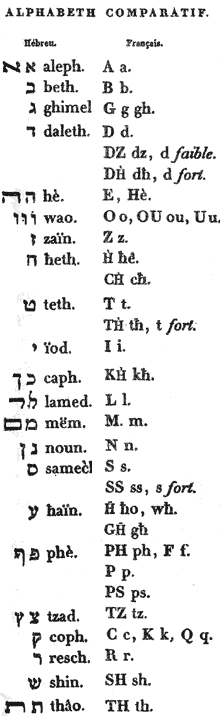
 S. This character as consonant, belongs to the sibilant sound, and is applied as onomatopoeia to depicting all sibilant noises: certain observant writers among whom I include Bacon, have conceived this letter S, as the symbol of the consonantal principle, in the same manner that they conceived the letter S. This character as consonant, belongs to the sibilant sound, and is applied as onomatopoeia to depicting all sibilant noises: certain observant writers among whom I include Bacon, have conceived this letter S, as the symbol of the consonantal principle, in the same manner that they conceived the letter , or the aspiration H, as that of the vocal principle. This character is, in Hebrew, the image of the bow whose cord hisses in the hands of man. As grammatical sign, it is that of circular movement in that which is related to the circumferential limit of any sphere. , or the aspiration H, as that of the vocal principle. This character is, in Hebrew, the image of the bow whose cord hisses in the hands of man. As grammatical sign, it is that of circular movement in that which is related to the circumferential limit of any sphere.
Its arithmetical number is 60.
 SA. Every idea of circumference, tour, circuit,rotundity. SA. Every idea of circumference, tour, circuit,rotundity.
 Every round thing suitable for containing anything; as a sack, a bag. In a figurative sense, it is the action of emigrating, changing the place, taking one’s bag. Every round thing suitable for containing anything; as a sack, a bag. In a figurative sense, it is the action of emigrating, changing the place, taking one’s bag.
The Arabic , designates that which disturbs, harms. , designates that which disturbs, harms.
 (comp.) Covering for the feet, sandals. (comp.) Covering for the feet, sandals.
 SB. When this root is conceived as the product of the circumferential sign united to that of interior action SB. When this root is conceived as the product of the circumferential sign united to that of interior action , it expresses every idea of occasional force, cause, reason: but when it is the root , it expresses every idea of occasional force, cause, reason: but when it is the root , image of every conceivable fructification, joined by contraction to this same sign, then this root is applied to that which surrounds, circumscribes, envelops. , image of every conceivable fructification, joined by contraction to this same sign, then this root is applied to that which surrounds, circumscribes, envelops.
The Arabic contains in general all the acceptations of the Hebraic root; but inclining toward those which are more particularized in a physical sense than in a moral one. contains in general all the acceptations of the Hebraic root; but inclining toward those which are more particularized in a physical sense than in a moral one.
 Every kind of contour, circuit, girdle; a circumstance, an occasion, a cause. Every kind of contour, circuit, girdle; a circumstance, an occasion, a cause.
The Arabic has the same sense; but the primitive root has the same sense; but the primitive root having deviated toward the physical, signifies to distort a thing, to take the wrong side; to curse someone, to injure him, etc. having deviated toward the physical, signifies to distort a thing, to take the wrong side; to curse someone, to injure him, etc.
 (intens.) Action of turning, going round, circuiting, enveloping, circumventing, warning, converting, perverting, etc. (intens.) Action of turning, going round, circuiting, enveloping, circumventing, warning, converting, perverting, etc.
The Arabic signifies to put a thing upside down; to pour out, upset. signifies to put a thing upside down; to pour out, upset.
 SG. The circumferential sign united to the organic sign, constitutes a root whose purpose is to depict the effect of the circumferential line opening more and more, and departing from the centre: thence, SG. The circumferential sign united to the organic sign, constitutes a root whose purpose is to depict the effect of the circumferential line opening more and more, and departing from the centre: thence,
 All ideas of extension, augmentation, growth: physical possibility. See All ideas of extension, augmentation, growth: physical possibility. See
The Arabic offers in general, the same sense as the nebrew. offers in general, the same sense as the nebrew.
 SD. This root whose effect is opposed to that of the preceding one, characterizes, on the contrary, the circumferential line entering upon itself, and approaching the centre: thence, SD. This root whose effect is opposed to that of the preceding one, characterizes, on the contrary, the circumferential line entering upon itself, and approaching the centre: thence,
 All ideas of repression, retention, closing. All ideas of repression, retention, closing.
The Arabic has not separated from the Flebrew in the radical sense. As verb it is literally the action of closing. It must be remarked that the verb jU which signifies to master, to dominate, is attached to the root has not separated from the Flebrew in the radical sense. As verb it is literally the action of closing. It must be remarked that the verb jU which signifies to master, to dominate, is attached to the root > >  which indicates properly the hand, and the power of which it is the emblem. which indicates properly the hand, and the power of which it is the emblem.
 SEH. Root analogous to SEH. Root analogous to
The Arabic indicates the circumference of the buttocks: the rump.
 That which is round of form: a tower, a dome; the moon; a necklace; bracelets, etc. That which is round of form: a tower, a dome; the moon; a necklace; bracelets, etc.
 SOU. Root analogous to SOU. Root analogous to . .
The Arabic does not differ from the Hebrew as to the radical sense; but the developments of this root being applied in Arabic, to the idea of what is bent rather than to what is round, characterizes consequently, that which is bad rather than that which is good: thence the verbs does not differ from the Hebrew as to the radical sense; but the developments of this root being applied in Arabic, to the idea of what is bent rather than to what is round, characterizes consequently, that which is bad rather than that which is good: thence the verbs
 which express the state of what is bent, false, malicious, traitorous, depraved, corrupt, etc. which express the state of what is bent, false, malicious, traitorous, depraved, corrupt, etc.
 A veil, a garment which surrounds, envelops, undulates. A veil, a garment which surrounds, envelops, undulates.
 (comp.) Action of being extended by going away from the centre; yielding; offering a facility, a possibility. (comp.) Action of being extended by going away from the centre; yielding; offering a facility, a possibility.
 (comp.) Action of welding; closing, shutting; that which is secret, closed, covered. (comp.) Action of welding; closing, shutting; that which is secret, closed, covered.
 (comp.) Action of anointing. See (comp.) Action of anointing. See . .
 (comp.) That which shines, that which renders joyous. See (comp.) That which shines, that which renders joyous. See . .
 (comp.) A horse. See (comp.) A horse. See
 (comp.) That which finishes a thing; makes an end of it; to sweep away ; to fulfill. See (comp.) That which finishes a thing; makes an end of it; to sweep away ; to fulfill. See • •
 (comp.) That which turns around tends, is perverted, changes sides, is made adverse; that which is audacious, independent; that which is raised, bred,trained, turned, given a proper outline, directed etc. See (comp.) That which turns around tends, is perverted, changes sides, is made adverse; that which is audacious, independent; that which is raised, bred,trained, turned, given a proper outline, directed etc. See . .
 (comp.) Action of working in the shadow of something, of being covered with a veil, of seducing, persuading, etc. See (comp.) Action of working in the shadow of something, of being covered with a veil, of seducing, persuading, etc. See • •
 SZ. Root not used in Hebrew nor in Arabic. SZ. Root not used in Hebrew nor in Arabic.
 SH. Root not used in Hebrew. The Arabic SH. Root not used in Hebrew. The Arabic  expresses the action of being dissolved in water, ofbeing poured out, spread over, etc. The Chaldaic expresses the action of being dissolved in water, ofbeing poured out, spread over, etc. The Chaldaic signifies to swim; to wash, to be purified in water: the Syriac a ad Samaritan have the same sense. signifies to swim; to wash, to be purified in water: the Syriac a ad Samaritan have the same sense.
 Action of cleansing, washing. Action of cleansing, washing.
 Every idea of cleansing. Every idea of cleansing.
 (comp.) Every idea of subversion, sweeping away;a torrent. (comp.) Every idea of subversion, sweeping away;a torrent.
 (comp.) Every idea of the circulation of produce, of merchandise; action of negotiating, selling, buying, etc. (comp.) Every idea of the circulation of produce, of merchandise; action of negotiating, selling, buying, etc.
 (comp.) That which springs from corruption: that which swarms from putrid water. (comp.) That which springs from corruption: that which swarms from putrid water.
 ST. Root not used in Hebrew. The Arabic ST. Root not used in Hebrew. The Arabic  characterizes in general, a vehement, illegal action. The compound verb characterizes in general, a vehement, illegal action. The compound verb signifies literally to command with arrogance, to act like a despot signifies literally to command with arrogance, to act like a despot
 SI. Root analogous to SI. Root analogous to . The Arabic . The Arabic  coming from the radical idea taken in a good sense, characterizes that which is regular, equal; that which is made in accordance with its own nature: thus the verb has reference to milk which flows without being coming from the radical idea taken in a good sense, characterizes that which is regular, equal; that which is made in accordance with its own nature: thus the verb has reference to milk which flows without being drawn. drawn.
 (comp.) An extension: a thing which has yielded, which has gone away from the centre. In a restrict«! sense, scoria. See (comp.) An extension: a thing which has yielded, which has gone away from the centre. In a restrict«! sense, scoria. See
 (comp.) Curvature. See (comp.) Curvature. See . .
 SCH. The circumferential sign united by contraction of the rool SCH. The circumferential sign united by contraction of the rool , image of every restriction and exception, forms a root whose use is to characterize a thing which is round, closed, fitting to contain, to cover; thence. , image of every restriction and exception, forms a root whose use is to characterize a thing which is round, closed, fitting to contain, to cover; thence.
 A sack, veil, covering of any sort: that which envelops, covers, obstructs. In a figurative sense, the multitude of men which cover the earth; ointment with which the skin is covered and which closes the pores. See A sack, veil, covering of any sort: that which envelops, covers, obstructs. In a figurative sense, the multitude of men which cover the earth; ointment with which the skin is covered and which closes the pores. See . .
The Arabic has preserved few of the expressions which hold to the radical sense. Its principle developments spring from the onomatopoetic root has preserved few of the expressions which hold to the radical sense. Its principle developments spring from the onomatopoetic root which depicts the effect of the effort that one makes in striking. Literally it is striking a thing to make it yield. which depicts the effect of the effort that one makes in striking. Literally it is striking a thing to make it yield.
 SL. Every kind of movement which raises, exalts, takes away, ravishes. SL. Every kind of movement which raises, exalts, takes away, ravishes.
The Arabic signifies in a restricted sense, to draw to one’s self. signifies in a restricted sense, to draw to one’s self.
 In a very restricted sense, a leap, a gambol; in a broad and figurative sense, the esteem or value that is put upon things. Also a heap of anything; a thing formed of many others raised one upon another, as a mound of earth, etc. In a very restricted sense, a leap, a gambol; in a broad and figurative sense, the esteem or value that is put upon things. Also a heap of anything; a thing formed of many others raised one upon another, as a mound of earth, etc.
 SM. The circumferential sign being universalized by the collective sign SM. The circumferential sign being universalized by the collective sign , becomes the symbol of the olfactory sphere, of every fragrant influence given to the air: thence, , becomes the symbol of the olfactory sphere, of every fragrant influence given to the air: thence,
 Every kind of aromatic. Every kind of aromatic.
The Arabicappears to have preserved more of the developments and even more of the radical force than the Hebraic analogue. This root characterizes that which is penetrated with force whether good or evil. Thence, in the modern idiom the verb even more of the radical force than the Hebraic analogue. This root characterizes that which is penetrated with force whether good or evil. Thence, in the modern idiom the verb , which signifies to bore a hole, to pierce. , which signifies to bore a hole, to pierce.
 SN. The circumferential sign having attained SN. The circumferential sign having attained
its greatest dimension by the addition of the augmentative sign, , becomes the symbol of the visual sphere and of all luminous influence: thence, , becomes the symbol of the visual sphere and of all luminous influence: thence,
 Every kind of light, of bright colour, in general; in particular the colour red, as the most striking. This colour, taken in a bad sense, as being that of blood, has furnished the idea of rage and rancour in the Chaldaic Every kind of light, of bright colour, in general; in particular the colour red, as the most striking. This colour, taken in a bad sense, as being that of blood, has furnished the idea of rage and rancour in the Chaldaic  ; but the Syriac has only a luminous effect, as is proved by the word ib which signifies the moon. The Hebrew has drawn from it the name of the most brilliant month ' of the year, ; but the Syriac has only a luminous effect, as is proved by the word ib which signifies the moon. The Hebrew has drawn from it the name of the most brilliant month ' of the year, the month of May. See the month of May. See > >
The Arabic characterizes that which illumines things and gives them form by shaping, polishing them; in the modern idiom the verb characterizes that which illumines things and gives them form by shaping, polishing them; in the modern idiom the verb signifies to sharpen. signifies to sharpen.
 SS. The circumferential sign being added to itself, constitutes a root which denotes in an intensive manner every eccentric movement tending to increase a circle and give it a more extended diameter: thence, every idea of going away from the centre, of emigration, travel: thence, SS. The circumferential sign being added to itself, constitutes a root which denotes in an intensive manner every eccentric movement tending to increase a circle and give it a more extended diameter: thence, every idea of going away from the centre, of emigration, travel: thence,
 A horse; that is to say an animal which aids in emigration, travel. See A horse; that is to say an animal which aids in emigration, travel. See . .
The Arabic belongs evidently to the primitive root belongs evidently to the primitive root , and designates in general, a thing which is caried from the centre to the circumference, to administer, to govern. , and designates in general, a thing which is caried from the centre to the circumference, to administer, to govern.
 SH. That which is rapid, audacious, vehement, SH. That which is rapid, audacious, vehement,
fitted for the race; thence,
 A vouiier, a thing which rushes; figuratively an arrogant person, a calumniator. A vouiier, a thing which rushes; figuratively an arrogant person, a calumniator.
The Syriac has the same sense as the Hebrew. has the same sense as the Hebrew.
The Arabicappears to have deviated much from the radical sense. It is literally, a straw; but figuratively, it is that which makes the subject of a deliberation. It is literally, a straw; but figuratively, it is that which makes the subject of a deliberation.
 (comp.) That which serves for support, prop, corroboration. See (comp.) That which serves for support, prop, corroboration. See . .
 (comp.) That which is extended by branching out; a genealogy; a series. (comp.) That which is extended by branching out; a genealogy; a series.
 (comp.) A violent, tumultuous movement; a tempest, a storm. (comp.) A violent, tumultuous movement; a tempest, a storm.
 SPH. Every idea of summit, end, finish; anything which terminates, consummates, achieves. SPH. Every idea of summit, end, finish; anything which terminates, consummates, achieves.
 The extremity of a thing, the point where it ceases; its achievement, consummation, end: the defection, the want of this thing: the border, top, summit, threshold; that which commences or terminates a thing; that which is added for its perfection: also, reiteration of the same action, an addition, supplement; the final thing where many others come to an end: a time involving many actions. The extremity of a thing, the point where it ceases; its achievement, consummation, end: the defection, the want of this thing: the border, top, summit, threshold; that which commences or terminates a thing; that which is added for its perfection: also, reiteration of the same action, an addition, supplement; the final thing where many others come to an end: a time involving many actions.
The Arabic has preserved of the radical sense only the idea of a thing reduced to powder, which is taken as medicine. The Syriac bib characterizes every kind of consummation, of reducing to powder by fire. has preserved of the radical sense only the idea of a thing reduced to powder, which is taken as medicine. The Syriac bib characterizes every kind of consummation, of reducing to powder by fire.
 (intens.) Action of approaching, drawing near, touching the threshold, receiving hospitality. (intens.) Action of approaching, drawing near, touching the threshold, receiving hospitality.
 STZ. Root not used in Hebrew nor in Arabic. STZ. Root not used in Hebrew nor in Arabic.
 SCQ. Root not used in Hebrew. The Samaritan SCQ. Root not used in Hebrew. The Samaritan , likewise the Syriac , likewise the Syriac , indicate a movement of evasion, of leaving; of germination. , indicate a movement of evasion, of leaving; of germination.
The Arabic is an onomatopoetic root which designates the action of striking. is an onomatopoetic root which designates the action of striking.
 SR. The circumferential sign joined to that of movement proper, constitutes a root whence issne all ideas of disorder, perversion, contortion, apostasy; also those of force, audacity, return, education, new direction, etc. SR. The circumferential sign joined to that of movement proper, constitutes a root whence issne all ideas of disorder, perversion, contortion, apostasy; also those of force, audacity, return, education, new direction, etc.
The Arabic offers in general, the same radical character as the Hebrew but its developments differ quite obviously. The verb offers in general, the same radical character as the Hebrew but its developments differ quite obviously. The verb signifies in particular, to be diverted; that is to say, turned from serious occupations. signifies in particular, to be diverted; that is to say, turned from serious occupations.
 (comp.) That which is disordered, rebellious, refractory; which leaves its sphere to cause trouble, discord; that which is vehement, audacious, independent, strong: that which distorts, turns aside takes another direction; is corrected, etc. See (comp.) That which is disordered, rebellious, refractory; which leaves its sphere to cause trouble, discord; that which is vehement, audacious, independent, strong: that which distorts, turns aside takes another direction; is corrected, etc. See . .
 SSH. Root not used in Hebrew nor in Arabic. SSH. Root not used in Hebrew nor in Arabic.
 STH. Every kind of mutual, sympathetic covering, every kind of veil, of darkness. STH. Every kind of mutual, sympathetic covering, every kind of veil, of darkness.
The Arabic indicates the parts of the human body that must be veiled. The Hebrew, as well as the Chaldaic indicates the parts of the human body that must be veiled. The Hebrew, as well as the Chaldaic , characterizes winter, the dark season when nature is covered with a veil See , characterizes winter, the dark season when nature is covered with a veil See . .
|
Commentaires, renvois
et illustrations
|
 Translate